
Embroidery Business for Sale
If you’re searching for an embroidery business for sale, you’re likely looking for a proven category with repeat B2B demand, uniforms, team apparel, and “official” branded gear that businesses reorder as they hire and grow.
Exploring Your Options in the Embroidery Business Market
If you’re searching for an “embroidery business for sale,” you’re likely evaluating a few different options:
- Buy an existing shop with equipment, clients, and cash flow
- Start a new embroidery business but want a clearer path than “trial-and-error”
- Invest in a franchise model that sells embroidery and more without being limited by in-house production constraints
The challenge: embroidery can look simple from the outside, but strong operators win through accounts, reorder programs, quoting discipline, supplier reliability, and proof/approval workflows, not just investment into machines to decorate apparel.
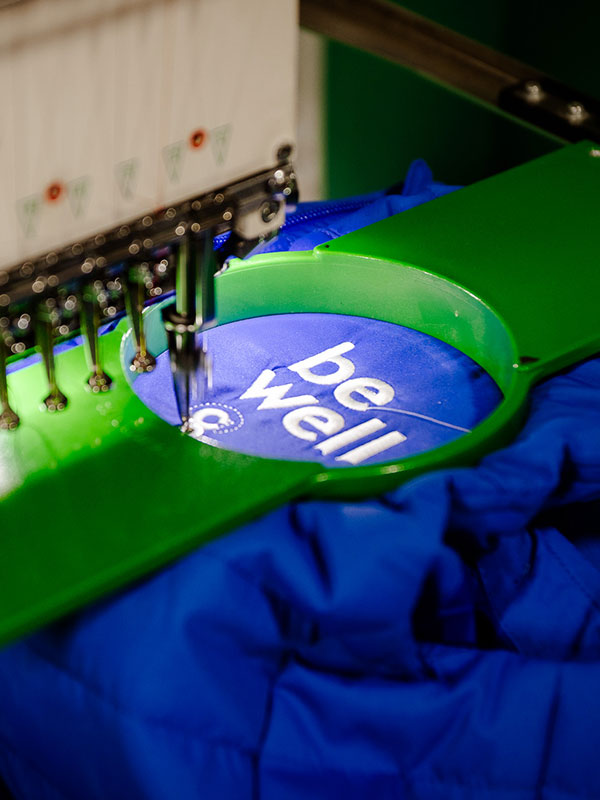
Market reality: embroidery demand is tied to repeat programs (not trends)
Embroidery sits inside the broader decorated apparel market, which is estimated at $28.98B (2023) and projects to reach $68.17B by 2030 (13% CAGR 2024–2030). Within that category, breakdown embroidery is a major revenue segment (with 2023 segment revenue reported in the billions).
Why that matters for an owner: embroidery demand is often driven by operational needs, uniforms, role-based apparel, and brand consistency where orders repeat because the business itself is in motion (new hires, replacements, seasonal outerwear, site crews, multi-location standards).
Who buys embroidery (and why they reorder)
Embroidery shows up wherever a brand needs to feel credible, and consistent, especially in local B2B:
Trades and construction
crews, safety gear, hats, outerwear
Medical and dental
staff uniforms, front desk, clinical teams
Hospitality
FOH/BOH uniforms, seasonal refreshes
Local corporate and field teams
polos, jackets, onboarding kits
Schools and boosters
spirit wear, staff, athletics
Once an account standardizes a look, embroidery becomes part of their operating rhythm, hiring, replacements, growth, and scheduled refresh cycles.
Is an embroidery business profitable?
Profitability depends on account mix, reorder rate, pricing discipline, production strategy (in-house vs. partner production), and how well you control:
- Quoting + proofs + approvals (time leakage is margin leakage)
- Supplier reliability (rush orders, substitutions, delays)
- Program structure (uniform programs, portals, reorder cycles)
Buy an existing embroidery shop vs. start fresh vs. franchise
If you’re searching for an embroidery business for sale, you’re typically weighing three paths. One option is to buy an existing independent embroidery shop. That can provide a running start, equipment already in place, a team, and established accounts. The key question is what you’re inheriting beyond the machines: how consistent the quality control is, how clean the proofing and approval workflow runs, whether vendor pricing is competitive, and how dependent the customer book is on the previous owner’s relationships. In many cases, the first real challenge isn’t production; it’s retaining accounts and standardizing the process, so reorders stay smooth after ownership changes.
Another path is starting an embroidery business independently from scratch. That gives you total control, but it also means building everything at once: sourcing and vendor relationships, pricing discipline, your proofing process, the service menu, and most importantly, how you’ll consistently win B2B accounts. You’re not just learning embroidery; you’re learning how to run a repeatable account-based business while funding the learning curve in time, rework, and early-stage mistakes.
A franchise model is designed to shorten that ramp. Instead of piecing together the blueprint on your own, you launch with training, established workflows, and a model built to win local B2B uniform and team apparel programs, where embroidery is a core, repeatable demand driver. You also gain purchasing leverage and vendor access that can help protect margins and reduce early missteps, so you can focus on building relationships and accounts rather than reinventing the operating system.
How much does it cost to start and embroidery business?
If you start an embroidery business independently, the upfront cost can swing widely because most of the “big” decisions are variable. Your investment depends on whether you’re building a home-based operation or a commercial setup, whether you’re buying one machine or scaling capacity, and how you plan to handle digitizing, proofs/approvals, blanks, and fulfillment. The cost categories are fairly consistent, equipment and setup, software/workflow tools, supplies and blanks, space/buildout, marketing/sales materials, and working capital, but the unknowns come from selection and trial-and-error: the wrong equipment mix, underestimating working capital, inconsistent vendor pricing, and the hidden cost of rework (mis-stitches, mis-sizing, rush freight, and redo orders). In other words, the independent path can look cheaper on paper at first, but it’s easier to miss the “all-in” cost of building a repeatable operation and reliable customer experience.
With a franchise model, you still have variables (especially real estate and how quickly you staff up), but the investment is more disclosed and structured because the franchisor provides a defined launch framework and Item 7 ranges you can budget around.
With Fully Promoted, the total estimated initial investment is between $129,386 to $393,552 (with real estate being the largest variable). The same disclosed ranges break out major categories you’d otherwise be guessing at independently—such as the $49,500 initial franchise fee, an equipment package of $48,250 to $223,743 (plus taxes), initial marketing of $6,600 to $13,200, and additional funds (0–6 months) of $22,000 to $60,500.
That “certainty” doesn’t mean every owner spends the exact same amount, but it does mean you’re budgeting off a disclosed framework instead of discovering costs as you go. And because the model is designed around B2B programs (uniforms, team apparel, and repeat orders), the goal is to reduce expensive early missteps, while using established workflows, vendor programs, and launch support to help you get to consistent execution faster.
How to get started (the smart path)
1
Decide whether your goal is owner-operator or manager-run
2
Validate local demand (uniform-heavy industries, team growth, multi-location businesses)
3
Compare models on sales support + vendor access + systems + reorder programs
If you’re evaluating an embroidery business for sale, the real question is whether you want to buy a shop or buy a repeatable model with multiple revenue streams designed to help you launch, win accounts, and grow with fewer unknowns. Independent ownership can work, but you’re building the operating system yourself: vendor relationships, pricing discipline, workflows, quality controls, and the sales motion that turns one-time orders into long-term programs.
Franchise ownership is designed to shorten that curve. With a franchise, you start with training, proven processes, and established support, plus vendor access and buying power that can help protect margins and reduce early-stage mistakes. And you launch with a brand that can open doors faster in local B2B, helping you earn trust and build repeat relationships sooner. If you want the upside of owning an embroidery business, without having to invent every part of it from scratch, exploring a franchise model like Fully Promoted is often the smartest next step.
Download the Franchise Kit or schedule a call to review territories and what it takes to get started.
Frequently Asked Questions
Is embroidery demand seasonal?
Some categories spike seasonally (outerwear, events, school cycles), but the stronger embroidery businesses rely on year-round uniforms and team programs tied to hiring, replacements, and growth, less “holiday-only,” more operational.
Do I need embroidery experience?
You need business discipline more than technical expertise—quoting accuracy, customer guidance, proofing discipline, and account development.
Next Steps
If you’re evaluating an embroidery business for sale, the real decision is whether you want to buy a shop, or buy a repeatable model designed for B2B reorder programs. Fully Promoted is built to help owners win relationships, program structure, and account expansion, not one-off transactions. Schedule a call to see how the model works.